
From ‘Earth Changes Media’
Additional science about planetary heating. Is it significant?
Though the Earth has cooled since its formation, the core of the Earth may be still as hot as 7000 K. The main source of Earth’s internal heat is produced through decay of radiogenic isotopes, in particular radioisotopes of uranium, thorium and potassium. This process provides a continuing heat source in the Earth’s interior.
A paper published in Nature Geosciences describes how Berkeley Lab scientists joined their KamLAND colleagues to measure the radioactive sources of Earth’s heat flow. Kamioka Liquid Scintillator Antineutrino Detector (KamLAND) is a project at the Kamioka Observatory, an underground neutrino observatory near Toyama, Japan.
Geologists have used temperature measurements from more than 20,000 boreholes around the world to estimate that some 44 terawatts (44 trillion watts) of heat continually flow from Earth’s interior into space. Where does it come from?
Radioactive decay of uranium, thorium, and potassium in Earth’s crust and mantle is a principal source of the heat. Geoneutrinos are byproducts of this nuclear reaction. In 2005 scientists in the KamLAND collaboration, based in Japan, first showed that there was a way to measure the contribution directly. The trick was to catch what KamLAND dubbed geoneutrinos – more precisely, geo-antineutrinos – emitted when radioactive isotopes decay.
Neutrinos are elementary particles with nonzero mass and travel close to the speed of light. Anitneutrinos are antiparticles of neutrinos produced in some nuclear decays. Neutrinos are also part of the background radation.
“As a detector of geoneutrinos, KamLAND has distinct advantages,” says Stuart Freedman of the U.S. Department of Energy‘s Lawrence Berkeley National Laboratory (Berkeley Lab), which is a major contributor to KamLAND. Freedman, a member of Berkeley Lab’s Nuclear Science Division and a professor in the Department of Physics at the University of California at Berkeley, leads U.S. participation. “KamLAND was specifically designed to study antineutrinos. We are able to discriminate them from background noise and detect them with very high sensitivity.”


This extract from above:
“Geologists have used temperature measurements from more than 20,000 boreholes around the world to estimate that some 44 terawatts (44 trillion watts) of heat continually flow from Earth’s interior into space. Where does it come from?”
More to the point, where does it go? What contribution does it make to the atmospheric and surface heating that we (well, some of us), are excited about?
One answer is, from http://wattsupwiththat.com/2011/07/21/20-trillion-watts-is-not-even-trenberths-missing-heat/
To convert the estimate in the MSNBC news article to watts per meter squared, 20 trillion watts must be divided by the area of the Earth [5.1 x 10^14 meter squared] which yields a heat source of 0.039 watts per meter squared.
This is well less than the significant radiative forcings as estimated in figure SPM.2 in the 2007 IPCC WG1 report and, except for local effects where lava flows and volcanic eruptions are occuring , this heat is of minor climatic importance [the outgassing of sulphur dioxide and other chemicals and of ash, of course, are a different issue]. The heating of the interior and resulting effect on currents in the Earth’s mantle, however, are important in climate on very long time scales as this helps drive plate tectonics, such as continental drift.
Related articles
- Nuclear decay said key to heating Earth (cbsnews.com)
- Geoneutrinos confirm that half of the heat from the earth’s interior is from the decay of Uranium and thorium (nextbigfuture.com)
- Earth’s original heat store still burning strong (blogs.nature.com)
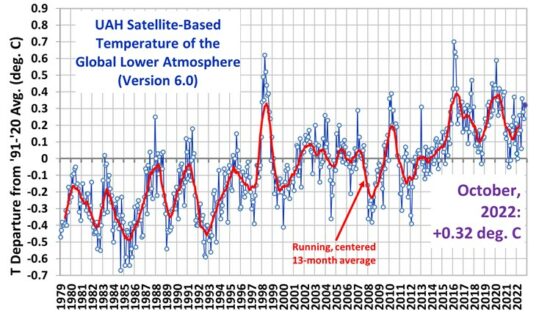


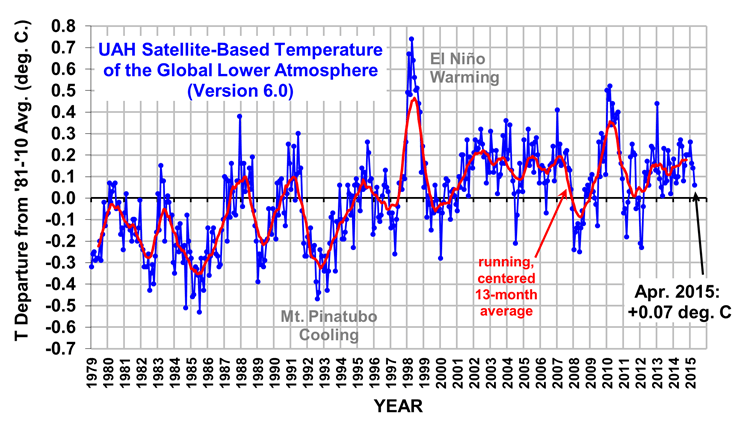


 The GOLDEN RULE
We can say that materials like uranium,thorium and potassium cause heat in the earth and eventually cause natural changes.
Pingback: Geoff with a G This is a pingback which has some relevance.
His pointing out the current extreme heat in parts of the northern hemisphere is of interest. This is being attributed, of course, to gloabal warming.
On the other hand, also in the NH, the UK is experiencing extreme cold even though it is also summer there. (Ref: Possible ‘Little Ice Age’ for Ireland could last 11 years as sun cools)
In the SH the winter weather seems to be colder than normal.
Two comments:
1. If there is such a figure as “average global”, (the existing methods for computing this are almost certainly suspect), what is it? The silly thing is that the above mentioned extremes are up to several degrees away from normal, but the average “global” difference might be actually less than 1 degree, and might even be a cooling difference. Certainly the basically local heat excess in one general area cannot be logically linked to a planetary heating trend.
Those who would argue that a small overall warming can tip a balance and cause catastrophic changes have not found much support from any scientists other than those in the IPCC and related organizations.
2. There is anecdotal evidence (ref: http://justmeint.wordpress.com/2011/07/08/wisdom-and-warning/)
regarding the possible or even obvious change in the earth’s orientaion to the sun. If this is true, much climate change would certainly result. Not in any way connected to carbon emissions.
All good food for thought.
Pingback: Geoff with a G. Thanks for sharing, Ken. I like your blog, and what it stands for. Nice aspiration. It’s also a really clean-looking design and well mapped. Good job. Keep up the good work.