
The approach of the solar maximum is an urgent reminder that power grids everywhere are more vulnerable than ever to geomagnetic effects
This post by John Kappenman, ref. http://spectrum.ieee.org/energy/the-smarter-grid/a-perfect-storm-of-planetary-proportions/0
Photo: Solar Dynamics Observatory/NASA
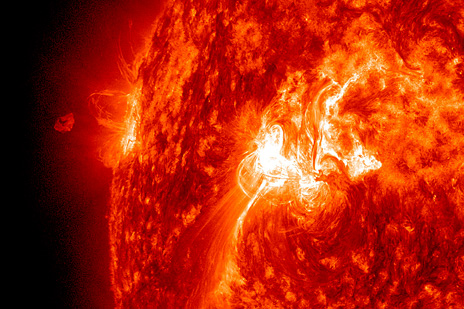
Flare Up: The sun emits an M-class (moderate level) flare, as captured by NASA’s Solar Dynamic Observatory on 25 September 2011. Solar flares and coronal mass ejections are the primary ways in which the sun can trigger geomagnetic storms here on Earth. With solar activity expected to peak in late 2012 or 2013, concerns rise that a geomagnetic superstorm could disrupt power grids all over the world.
Luminous fingers of intense red, green, and violet light flicker and pulse across the northern and southern skies like a vast cosmic conflagration. Within minutes, millions of people are tweeting, texting, and blogging about the wondrous sight. But then the sky turns a deep blood red, and fascination turns to panic.
Linked to the celestial spectacle are enormous fluctuations of the magnetic field in Earth’s magnetosphere, which are causing immense flows of electric current in the upper atmosphere over much of the planet. Those huge currents disturb Earth’s normally quiescent magnetic field, which in turn induces surges of current in electrical, telecommunications, and other networks across entire continents. Streetlights flicker out; electricity is lost. A massive planetary blackout has occurred, leaving vast swaths of North and South America, Europe, Australia, and Asia without power.
Within a few months, the crisis has deepened. In many areas, food shortages are rampant, drinking water has become a precious commodity, and patients in need of blood transfusions, insulin, or critical prescription drugs die waiting. Normal commerce has ground to a halt, replaced by black markets and violent crime. As fatalities climb into the millions, the fabric of society starts to unravel.
Of course, no geomagnetic storm has ever wreaked such global havoc. But the last time we had a truly powerful storm was in 1921—decades before developed economies became utterly dependent on electrical infrastructure. The doomsday scenario described above is based closely on the warnings of numerous government panels and industry studies I’ve participated in during my more than 30 years of investigating the problem that extreme space weather poses to power grids. A 2008 U.S. government report prepared for the Federal Emergency Management Agency put the yearly financial impact of such an event at more than US $1 trillion. And like other reports before and since, it predicted catastrophic damage not just to electricity grids but also to oil and gas pipelines, undersea communication cables, telephone networks, and railways. Repairing that critical infrastructure would take months or even years.
Now is a good time to consider the awesome and cyclical tempestuousness of our star: Solar activity tends to occur in cycles that peak in frequency and intensity every 11 years, and the next peak is expected later this year or early the next. To be sure, not every peak—also known as a solar maximum—brings a killer storm; the last notable one occurred in March 1989. It took down Quebec’s entire grid within seconds, leaving 6 million customers without power for 9 hours. A later surge in the storm destroyed a large transformer at a New Jersey nuclear plant and nearly took down U.S. power grids from the mid-Atlantic through the Pacific Northwest.
Continued here:
H/T Clare JustMe in T
Related articles
- Space weather expert has ominous forecast (whptv.com)




 The GOLDEN RULE